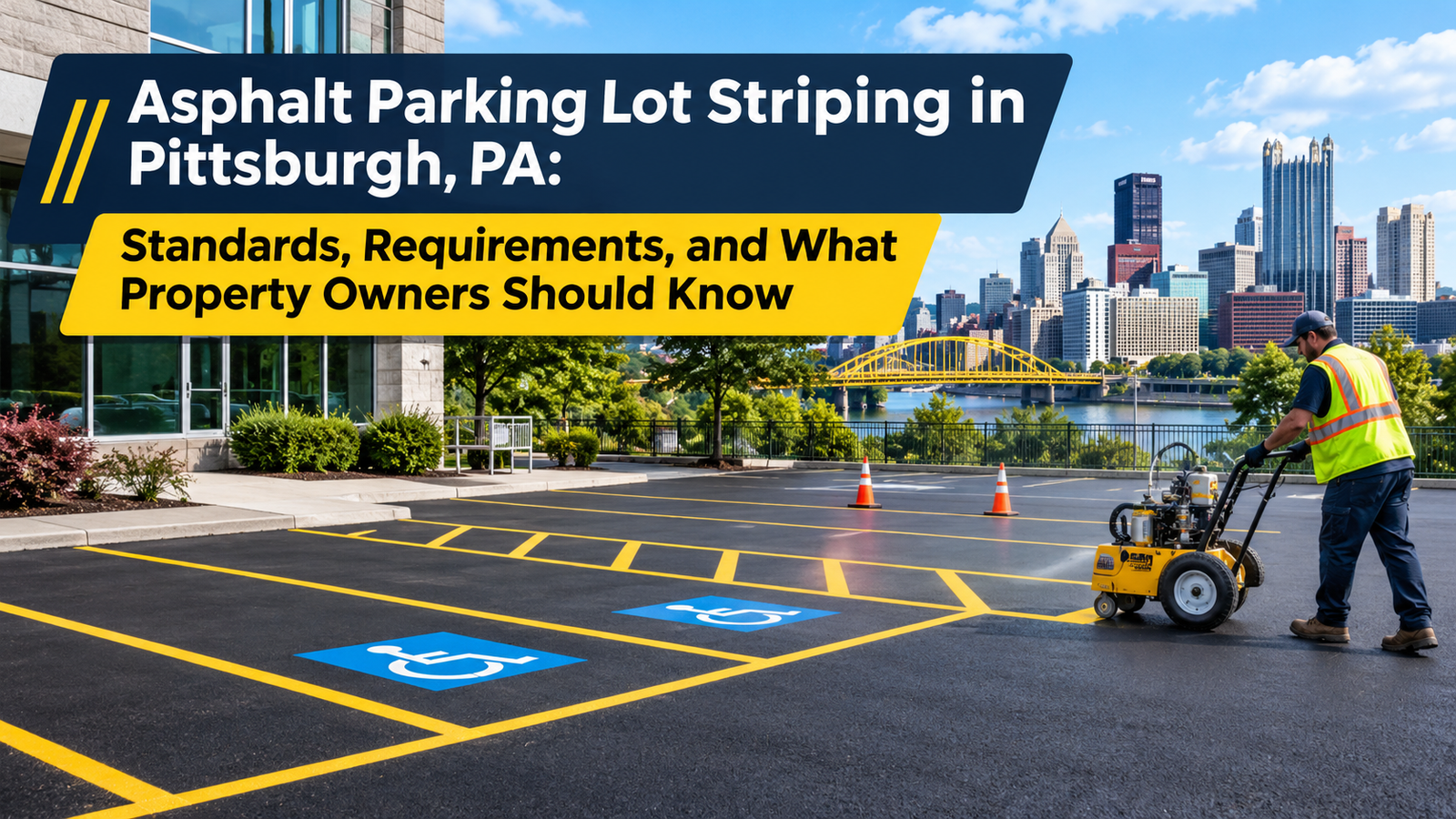
Parking lot striping the painted lines, arrows, symbols, and markings that define parking spaces, traffic flow, accessible routes, and fire lanes is both a functional necessity and a legal requirement for commercial parking facilities in Pittsburgh. Well-striped asphalt parking lot striping Pittsburgh lots guide drivers safely and efficiently, maximize the number of vehicles the lot can accommodate, clearly delineate accessible parking for people with disabilities, and maintain compliance with the ADA and the City of Pittsburgh’s parking and building codes. Faded, missing, or non-compliant striping creates confusion, reduces parking capacity, and can expose property owners to code enforcement and ADA liability.
ADA Requirements for Parking Lot Striping in Pennsylvania
The Americans with Disabilities Act (ADA) establishes minimum requirements for accessible parking that apply to essentially all commercial parking facilities in Pittsburgh. These requirements are enforced through Pennsylvania’s Uniform Construction Code and the City of Pittsburgh’s building regulations, and they set the minimum standards that any compliant striping layout must meet. The key ADA requirements for parking lot striping are: accessible space dimensions (8 feet minimum width for standard accessible spaces, 11 feet for van-accessible spaces); access aisle width (5 feet for standard accessible spaces, 8 feet for van-accessible spaces); the access aisle must be part of an accessible route to the building entrance; and the accessible spaces and access aisles must be located on the flattest available portion of the lot (maximum 1:48 slope in both directions).
The number of accessible spaces required depends on the total parking lot capacity. The ADA minimums range from 1 accessible space per 25 total spaces at smaller lots, to 20 plus 1 for every 100 spaces over 1,000 for very large lots. At least one of every six accessible spaces (and at least one overall) must be van accessible, with the wider 11-foot space and 8-foot access aisle. The International Symbol of Accessibility must be painted on the pavement of each accessible space or on a sign at the head of the space; vertical signs are required for each accessible space meeting specific size and height requirements.
Non-compliance with ADA parking requirements exposes commercial property owners in Pittsburgh to federal civil rights enforcement complaints and private lawsuits. The ADA’s private right of action allows disabled individuals to sue for injunctive relief (requiring the property owner to bring the lot into compliance), and in some cases attorney’s fees. Pittsburgh’s commercial property owners who have not recently reviewed their parking lot against current ADA standards should do so, as standards have been updated and enforcement has increased.
Fire Lane Marking Requirements in Pittsburgh
The City of Pittsburgh Fire Prevention Code requires that fire lanes the designated areas that must remain clear for fire department access be marked to prevent parking. Fire lane markings in Pittsburgh typically consist of red-painted curbs (where curbs are present), yellow-painted pavement markings reading “FIRE LANE NO PARKING” at regular intervals, and signage meeting Pittsburgh Fire Bureau specifications. Fire lane width, length, and location requirements are determined by the Pittsburgh Fire Bureau based on the building type, construction, and fire suppression features, and are part of the site plan review process for new commercial development.
Maintaining fire lane markings is an ongoing property owner obligation in Pittsburgh. Faded or missing fire lane markings are a code violation that can be cited in fire inspections. When parking lot surfaces are re-striped, re-painting the fire lane markings to maintain their visibility is part of the standard scope of work.
Pavement Marking Materials for Pittsburgh’s Climate
The choice of pavement marking material significantly affects how long the striping lasts in Pittsburgh’s demanding climate. The options available to Pittsburgh parking lot owners are: water-based latex traffic paint, oil-based alkyd paint, thermoplastic markings, and epoxy markings. Each has different performance characteristics in freeze-thaw conditions, different application requirements, and different durability.
Water-based latex traffic paint is the most common material for parking lot striping in Pittsburgh because of its low cost, fast dry time, and ease of application. Its durability in Pittsburgh’s climate is moderate a quality latex parking lot paint will typically remain legible for 2 to 4 years on a sealed asphalt surface before re-striping is needed. It is applied by airless spray at a specified wet film thickness and must be applied to a clean, dry surface. Portland cement concrete surfaces require a primer before latex paint adhesion is reliable.
Thermoplastic markings applied by melting a solid thermoplastic material and extruding or screeding it onto the pavement provide significantly longer life than paint: 5 to 10 years for parking lot applications. Thermoplastic is more commonly used for high-traffic roadway markings (intersection lines, crosswalks, and centerlines) than for parking lots, but it is a viable choice for Pittsburgh property owners who want to minimize re-striping frequency. It requires specialized application equipment and is more expensive than paint per linear foot.
The Striping Process: Preparation and Application
Proper surface preparation before striping is as important as the material choice for durability. The pavement surface must be clean free of dirt, dust, oil, loose material, and existing paint in poor condition. Pressure washing the lot before striping removes surface contamination that would prevent paint adhesion. Oil stains, common in parking lots from vehicle fluid drips, require degreasing treatment before painting because paint over oil stains will not adhere properly and will peel quickly.
Layout is the second preparation step: measuring and marking the stripe locations with chalk or string lines before painting begins. A well-laid-out parking lot maximizes the number of spaces for the available area, provides clear and logical traffic flow, and places the accessible spaces correctly relative to building entrances and access routes. For large lots or for lots being re-designed from an inefficient existing layout, computer-aided layout planning can optimize space count and traffic flow. Standard parking space dimensions in Pittsburgh commercial lots are typically 9 feet wide by 18 to 20 feet long, with 24-foot two-way drive aisles.
Re-Striping Timing and Maintenance Planning
Pittsburgh’s freeze-thaw winters are hard on pavement markings. Sand and salt applied to lot surfaces during the winter gradually abrade painted markings, and the mechanical action of snow removal equipment further erodes them. Most Pittsburgh commercial parking lots need re-striping every 2 to 3 years for traffic paint, with the timing driven by visibility rather than a fixed calendar schedule. When space lines are fading to the point that drivers are having difficulty identifying space boundaries leading to crooked parking and wasted space re-striping is overdue.
Re-striping should be coordinated with other pavement maintenance activities. If sealcoating is planned, the sealcoat must be applied and allowed to fully cure (typically 24 to 72 hours depending on temperature and humidity) before re-striping is performed paint applied to uncured sealer will not bond properly and will peel. When crack sealing and patching are part of a maintenance program, completing those activities before sealcoating and re-striping produces the best result.
Frequently Asked Questions: Asphalt Parking Lot Striping in Pittsburgh, PA
How many ADA accessible parking spaces does a Pittsburgh commercial lot need?
The ADA minimum is 1 accessible space per 25 total spaces for lots with 1 to 100 spaces; proportionally lower ratios apply at higher total counts (the minimums are set out in the ADA Standards for Accessible Design, Table 208.2). At least 1 in 6 accessible spaces must be van accessible. For a 50-space Pittsburgh parking lot, the minimum is 2 accessible spaces, at least 1 of which must be van accessible. Pennsylvania’s Uniform Construction Code adopts these federal minimums, and City of Pittsburgh permit review will check accessible space count during plan review.
How long does parking lot striping last in Pittsburgh?
Standard water-based latex traffic paint on a sealed asphalt surface in Pittsburgh lasts approximately 2 to 4 years before visibility deteriorates to the point of needing re-striping. Pittsburgh’s winters with sand and salt application and snow removal equipment traffic accelerate wear compared to warmer climates. Thermoplastic markings last 5 to 10 years. High-traffic areas like drive aisle arrows and entrance/exit markings wear faster than individual space lines and may need touch-up between full re-striping cycles.
Does Pittsburgh have specific parking lot striping standards?
The City of Pittsburgh’s parking regulations, the Pittsburgh Fire Prevention Code, and the ADA Standards for Accessible Design collectively establish the requirements for commercial parking lot striping in Pittsburgh. The fire code specifies fire lane marking requirements. The ADA sets the accessible parking dimension and quantity standards. Pittsburgh’s zoning code specifies minimum parking space counts for different uses, and the building code review process for commercial development includes parking lot layout review. For private lots not connected to current building permit activity, the ADA requirements are the most actively enforced through the federal civil rights framework.
Can parking lot striping be applied in winter in Pittsburgh?
Most traffic paints require surface temperatures above 50°F and rising, and air temperatures above 40°F, for proper application and curing. Pittsburgh’s winter temperatures frequently fall below these thresholds, making outdoor striping impractical from approximately November through March in most years. Interior parking structures with climate-controlled environments can be striped year-round. For outdoor lots, scheduling striping in spring (after the temperatures stabilize above 50°F) or fall (before temperatures drop below threshold) is the standard Pittsburgh practice.